AI SEO Services | Get Found in ChatGPT & AI Search | Hyxil

✨ AI SEO Agency · Trusted Since 2014

AI SEO Services That Get You Cited, Not Just Ranked

Traditional SEO gets you a blue link. AI SEO gets your brand named inside the answer, in ChatGPT, Gemini, Perplexity, and Google AI Overviews. We do both, because your customers use both.

✓ Get cited in ChatGPT & AI Overviews
✓ Track your AI visibility monthly
✓ Fix how AI describes your brand
✓ Rank in traditional search too
✓ Dedicated AI SEO strategist
✓ No long-term contracts
Why Choose Us 🤖
🤖

We Optimize for Both Searches

Most agencies chose a side: traditional SEO or AI search. We built for both, because your customers still Google and ask ChatGPT. One strategy, both channels, one team.

12+Years since 2014
4AI engines tracked
12+Years in business since 2014
4AI engines we track monthly
100+Businesses ranked since 2014
2-in-1Traditional SEO + AI search
Verified with Google Search Console · Ahrefs · Semrush · Custom AI visibility tracking
Definition

What Is AI SEO?

AI SEO means two different things, and you probably want both.

Search “AI SEO services” and you’ll find agencies selling two completely different products under the same name. Nobody explains the difference, so let’s fix that in the next sixty seconds.

1

Getting found by AI (GEO / AEO)

Optimizing so AI engines cite your brand inside their answers in ChatGPT, Gemini, Perplexity, and Google AI Overviews.

2

Using AI to scale SEO

Using AI tooling to execute traditional SEO faster and at greater scale: research, content, tracking, and reporting.

✨

Named inside the answer

When someone asks ChatGPT or Google, this decides whether your business is cited.

AEO: direct answers, snippets, voice
GEO: cited inside AI-generated responses
Same core discipline. Different labels.
We do both.
4AI engines tracked monthly
Definition 1. Getting found by AI
When someone asks ChatGPT “what’s the best CRM for a small law firm?”, or Google shows an AI Overview, the result is whether your business is named in that answer.
🎯
AEOGetting into direct answers, including featured snippets and voice.
✨
GEOGetting synthesized and cited inside AI-generated responses.
🔗
GoogleAI Overviews plus traditional blue-link rankings.
🤖
ChatGPT & GeminiBrand named in conversational answers.
📚
PerplexityCited in source-backed summaries.
Search has changed

Why AI SEO Matters Right Now

Search behavior has changed faster in the last two years than in the previous ten.

Your customers now open ChatGPT to ask which product to buy. They read Google’s AI Overview and never scroll. They ask Perplexity to compare three vendors and get a cited summary in ten seconds. None of this existed in a meaningful way three years ago.

📱

Answers, not just links

More searches now end with a named shortlist inside the AI.

Zero-click research is now the norm
AI answers compress the shortlist
Being cited builds trust before the click
The window is open for early movers
2-in-1Google + AI search
Zero-click
Research often ends in the answer

A growing share of searches never reach a website. The information transfer still happened inside the AI’s answer. Citation is how you stay part of it.

3 names
AI compresses the shortlist

Google’s page one shows ten options. ChatGPT names three. That compression is enormously valuable if you’re inside it.

Pre-sold
Trust before they land

When an AI recommends you, you arrive pre-endorsed. Prospects who reach your site via an AI citation typically convert better than cold organic traffic.

Open
Less contested than classic SEO

Most competitors haven’t started. Agencies that were early to local SEO in 2012 owned their markets for a decade. This is that moment again.

The honest part

Will AI search change your traffic?

Some informational visits will move into the answer itself. That’s a structural shift, not a strategy failure.

Commercial and transactional traffic is far more resilient. Someone comparing vendors, checking pricing, or ready to buy still clicks through. Brand and navigational traffic is unaffected.

The visitors who remain are further down the funnel. Measure citations, brand mentions in AI answers, and qualified leads, not sessions alone.

Get Your Free AI Visibility Audit →
✨
A business cited in ChatGPT
Wins
even if blog traffic softens
Fewer casual visitors. More qualified ones. That’s the shift worth building for.
The mechanism

How AI Engines Decide Who to Cite

Every agency promises to make you “citation-worthy.” Almost none explain what that actually means. Here’s the mechanism, in plain English.

1 Retrieval, not ranking+
When you ask ChatGPT or Perplexity a question, it doesn’t rank ten pages. It retrieves relevant passages from its index (or from a live web search), then synthesizes an answer from them. This is the single most important shift to understand: AI engines retrieve passages, not pages. Your beautifully written 3,000-word guide isn’t what gets cited. A specific 100-word chunk of it is. The structural question is no longer “is this page good?” but “is this individual passage self-contained, factual, and extractable?”
2 Chunking and embeddings+
Content gets split into chunks and converted into embeddings, which are mathematical representations of meaning. When a query comes in, the engine finds chunks whose meaning is closest to the question. A passage that requires the previous three paragraphs for context will lose to one that stands alone. Burying the answer under a long preamble means the chunk that gets retrieved doesn’t contain the answer. The structure that wins is a clear heading, then a direct answer, then the supporting detail. Vague marketing language has weak embeddings; specific factual language has strong ones. “We deliver world-class solutions tailored to your needs” retrieves for nothing. “Local SEO typically takes 3 to 6 months to produce meaningful ranking changes” retrieves for a real question.
3 Entity resolution+
The model needs to know who you are as a distinct entity, not a string of text. It builds that understanding from every mention of your business across the web: your site, your schema markup, directories, review platforms, news coverage, social profiles, and knowledge bases. If those sources disagree, with different names, different service descriptions, or conflicting details, the entity is fuzzy and the model won’t confidently name you. Entity clarity is the highest-leverage technical work in AI SEO.
4 Consensus and corroboration+
AI models weight agreement across independent sources. One page claiming you’re the best roofer in Ohio means nothing. Twelve independent sources, including reviews, directories, press, and industry sites, describing you consistently creates the corroboration a model needs to state it as fact. This is why digital PR and citation building matter more in AI SEO than in traditional SEO. Backlinks pass authority. Mentions build consensus. In AI search, consensus is what turns you from “a company” into “the company the model names.”
5 Trust and freshness signals+
Models weight source credibility and recency. Content with clear authorship, visible expertise, publication dates, cited sources, and recent updates gets retrieved more often than anonymous undated pages. This is E-E-A-T, and it matters more in AI search than in traditional search because a model staking its answer on your content is taking on more reputational weight than a search engine listing a link.
What this means in practice
Five things earn citations, in order of leverage. Everything in our AI SEO service maps to one of those five.
🏷️
Entity clarityThe model knows exactly who you are.
📐
Passage structureAnswers are extractable without surrounding context.
✍️
Specific factsNumbers, timelines, ranges, named processes.
📰
CorroborationMultiple independent sources agree about you.
🏅
Real expertiseAuthorship, credentials, first-hand data.
What we deliver

Our AI SEO Services

Every engagement is built from these components, weighted to your industry, your competition, and where your AI visibility currently sits.

🔍

AI Visibility Audit

We test how you currently appear across ChatGPT, Google AI Overviews, Perplexity, and Gemini against a defined set of prompts your buyers actually use. You get a baseline: where you’re cited, where competitors are cited instead, and what’s blocking you.

🏷️

Entity Optimization

Making sure AI models know exactly who you are. Complete schema implementation (Organization, Service, LocalBusiness, Person, FAQPage), consistent business data across 80+ platforms, knowledge panel and Wikidata work where applicable, and disambiguation from similarly-named entities.

📐

Answer-First Content Architecture

Restructuring content so passages are retrievable. Question-based headings, direct answers before elaboration, self-contained sections, comparison tables, and specific factual detail such as dates, numbers, ranges, and named methods that models can lift and cite.

✍️

AI-Optimized Content Production

New content built for both traditional ranking and AI citation. Topic clusters mapped to real buyer prompts, original data and first-hand insight (the thing AI cannot synthesize from elsewhere), clear authorship and credentials, and structure engineered for extraction.

📊

Structured Data Implementation

Complete schema coverage across your site. This is the most under-implemented, highest-leverage technical work in AI SEO. Most sites have partial schema or none, and it’s the clearest signal you can send a model about what your content means.

📰

Digital PR & Citation Building

Earning the independent mentions that create consensus. Industry publications, expert commentary and quote sourcing, data-led PR that earns coverage, podcast and interview placements, and authoritative directory presence.

🛡️

AI Brand Monitoring

Tracking what AI engines actually say about you: accuracy, sentiment, and whether they recommend you or a competitor.

⚙️

Technical SEO Foundation

None of the above works on a site AI cannot crawl or parse. That includes Core Web Vitals, crawlability, clean semantic HTML, a sensible URL structure, internal linking, and llms.txt where it belongs. This is the same technical SEO foundation, applied so answer engines can read the site.

📈

AI Visibility Reporting

Monthly reporting on prompt-level citation frequency, share of voice against named competitors, sentiment analysis, referral traffic from AI platforms, and traditional rankings alongside, so you see both channels in one view.

Brand accuracy

What Is AI Saying About Your Brand Right Now?

Here’s a question almost no agency will ask you: have you actually checked what ChatGPT says about your company? Most business owners haven’t. When they do, the answer is often outdated, mixed up, or missing entirely.

1. Outdated informationThe model states pricing you abandoned two years ago, lists services you no longer offer, or names a location you’ve closed. It says it confidently, because models don’t hedge.
2. Confusion with another businessSimilar name, similar industry, different company, and the model merges you. Your reviews get attributed elsewhere; someone else’s problems get attributed to you.
3. Competitor substitutionSomeone asks the AI about your category in your city. It names three companies. You’re not one of them. This is the most expensive miss, and the most common.
4. Sentiment driftThe model has absorbed a handful of negative reviews or an old complaint thread and reflects that tone whenever your brand comes up, even when the overall picture is strongly positive.
1

Baseline testing

We run a structured set of prompts across all four major engines: direct brand queries, category queries, comparison queries, and problem-led queries, and we document exactly what each returns.

2

Source tracing

When an answer is wrong, we find where the model learned it. Usually an outdated directory listing, a stale press mention, an old page you forgot existed, or a review platform with wrong data.

3

Correction at source

You can’t edit ChatGPT. You can correct the underlying sources it learned from, and then reinforce the accurate version across enough independent places that consensus shifts. This takes time but it works.

4

Ongoing monitoring

Because model outputs change as they retrain and re-retrieve, this isn’t a one-time fix. We track it monthly and flag drift before it costs you deals.

How we work

How We Do AI SEO For You

1Days 1 to 14AI Visibility Audit and Baseline
We build a prompt set from the questions your buyers actually ask, not from a keyword list. Then we test those prompts in ChatGPT, Google AI Overviews, Perplexity, and Gemini, and we write down every result. The same pass covers the entity audit, schema coverage, a technical crawl, and which competitors are being cited instead of you. You leave with a baseline that shows where you stand.
2Days 14 to 21Strategy and Prompt Map
We rank the prompts worth winning by commercial value and how hard they are right now. From that map we decide the content to build, the pages to restructure, the entity fixes, the citation and PR targets, and the KPIs with realistic milestones. You get the written strategy and a walkthrough call that explains each decision.
3Month 1 to 2Entity and Technical Foundation
Full schema goes on the site. Business data is corrected so the same facts appear across the platforms that models read. Technical fixes ship. High-value pages are rebuilt so the answer comes first. Brand corrections start at the source that taught the model the wrong fact. This phase is quiet, and it is where most of the later result comes from.
4Month 2 to 5Content and Corroboration
New content goes live on the prompt map. Digital PR earns mentions from places we do not control. We add original data and first-hand detail, the material a model cannot copy from a generic page. Citation building and traditional SEO run in the same period.
5Month 5 onwardMeasure, Expand, Defend
Prompt-level tracking shows what is working. We expand into nearby prompt groups and put more weight on the winners. Gaps where a competitor is cited get closed. Brand accuracy stays on a monthly check, because models retrain and a citation is maintained, not won once.

Early citation movement usually shows in 60 to 90 days. A steady presence across more than one engine usually takes 4 to 6 months. A promise of ChatGPT citations in three weeks does not match how retrieval and retraining work.

Reporting

How We Measure AI SEO

Ask most AI SEO agencies how they measure success and you’ll get “we track AI visibility.” That’s not an answer. Here’s ours.

1

Citation frequency

Of your defined prompt set, what percentage of responses name your brand? Tracked per engine, so you can see that (for example) Perplexity cites you 40% of the time while ChatGPT is at 15%, and we can work out why.

2

Share of voice

When your category comes up, what proportion of the named brands is you versus each competitor? This is the number that actually tracks competitive position.

3

Sentiment and accuracy

Not just whether you’re mentioned but how. Positive, neutral, or negative framing, and whether the information is correct. An inaccurate citation can be worse than none.

4

Citation source attribution

Which of your pages are being cited? This tells you which content formats and structures actually earn retrieval, so we can build more of what works.

5

AI referral traffic

Sessions arriving from ChatGPT, Perplexity, Gemini, and Copilot, tracked separately in analytics with proper attribution. Usually smaller in volume than organic, and usually higher in conversion rate.

Plus traditional SEO metrics, in the same report: rankings, organic sessions, conversions. Because you’re not abandoning traditional search, and seeing both channels in one view is the only way to understand what’s actually happening to your visibility.

🚀 Ready to Get Cited in AI Search?

Be the Answer Across
AI Search and Google

Partner with an AI SEO agency that gets your business cited in ChatGPT, Gemini, and Google AI Overviews and tracks real revenue from it. Get your free AI SEO audit and we’ll show you exactly what’s blocking your AI visibility.

Free audit with no obligation No long-term contracts Dedicated AI SEO strategist
Proof, not promises

Real Results

ECOMMERCE SEO VERIFIED GSC DATA

NYRA, London. UK lighting, showing in generative AI results

NYRA is a premium lighting brand in the UK. For the last 3 months, Google Search Console’s Generative AI report shows 39.4K impressions. That is the view we use to see whether Google is retrieving the brand inside AI answers.

39.4KGenerative AI impressions
3 monthsRange in the report
WebSearch type

This is a UK ecommerce client. The figure is generative AI impressions, not a local map ranking and not a promise that every prompt will name the brand.
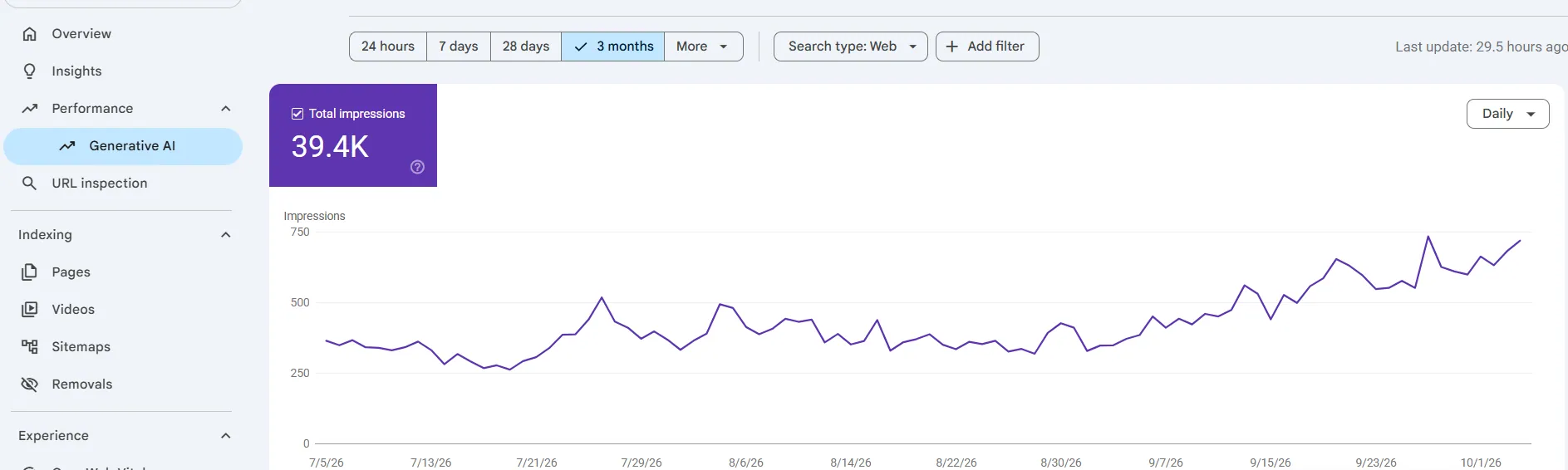
Google Search Console Generative AI report showing 39.4K total impressions over 3 months
Generative AI impressions, last 3 months. The report total is 39.4K.
Review the UK lighting ecommerce SEO case study Data: Google Search Console, Generative AI, last 3 months
Why Hyxil

Why Choose Hyxil as Your AI SEO Company

✓
We do both, and we say soMost agencies in this space are either traditional SEO shops that added an “AI” page, or AI-native startups with no SEO track record. We’re a 12-year SEO agency that built AI search into the core practice. Your foundation is real; your AI work is current.
✓
12 years of algorithm changes, since 2014We’ve worked through Panda, Penguin, Pigeon, BERT, the helpful content updates, and now the AI transition. Agencies built on shortcuts don’t survive those. Ours has.
✓
Automation nobody else hasOur n8n-certified engineers automate AI visibility tracking across four engines: more prompts, more often, faster alerts. Traditional agencies do this manually or not at all.
✓
We report brand accuracy, not just presenceBeing mentioned isn’t enough if the model is wrong about your pricing. We track what AI says about you and correct it at source.
✓
We build the website tooWordPress and Next.js in-house. AI SEO requires structural changes: schema, semantic HTML, content architecture. We implement rather than send recommendations and hope your developer executes them correctly.
✓
Honest about timelines and limitsWe’ll tell you what’s achievable in 90 days and what takes a year. We’ll also tell you if AI SEO isn’t your priority right now. No long-term contracts. We keep clients by performing.
🏆

A 12-year SEO agency, current on AI search

Foundation first. AI visibility on top. One team.

✓ Dedicated AI SEO strategist
✓ n8n-certified tracking
✓ In-house WordPress & Next.js
✓ Month-to-month, no lock-in
Fit

When AI SEO Isn’t Your Priority

Every agency page tells you why you need the service. Here’s when you don’t, or at least, not yet.

Your technical SEO foundation is brokenIf AI engines can’t crawl your site, if your pages don’t render, if Core Web Vitals are failing badly, fix that first. AI SEO builds on technical SEO; it doesn’t substitute for it.
You have no content at allGEO optimizes content for retrieval. If there’s nothing to retrieve, start with a content programme. We’ll tell you that rather than sell you the wrong thing.
You need leads next monthAI SEO is a 3 to 6 month play minimum. If you have an urgent pipeline gap, paid search will serve you better in the short term, and we will say so. Build AI SEO alongside, not instead.
Your customers genuinely don’t use AI searchSome niches, including certain trades, some older demographics, and some regulated industries, still see very little AI-driven discovery. We’ll check your category during the audit and tell you honestly what we find.
You’re expecting guaranteed citationsNobody can guarantee an AI model will name you. Anyone who does is either lying or misunderstanding how these systems work. We can substantially improve your odds and measure the improvement. That’s the honest offer.

If any of these describe you, tell us during the audit. We’d rather point you somewhere useful than take a retainer for the wrong service.

Who we help

AI SEO for These Kinds of Businesses

The questions change by category. The work does not: a clear entity, extractable answers, and sources that agree. Linked labels go to a live Hyxil page. Labels without a link do not have their own page yet. A case study is linked only where we have published proof, which on this page is NYRA.

Professional services
Law firmsAccountantsConsultantsFinancial advisorsInsurance
B2B and SaaS
SoftwareAgenciesManufacturingLogistics
eCommerce and retail
Online storesShopify brandsMulti-channel retail
Hospitality and real estate
HotelsRestaurantsReal estateProperty management
Questions

AI SEO Services: Frequently Asked Questions

What are AI SEO services?+
AI SEO services cover two related disciplines. The first is optimizing so AI engines like ChatGPT, Google AI Overviews, Perplexity, and Gemini cite your brand in their answers, often called GEO or AEO. The second is using AI tooling to execute traditional SEO faster and at greater scale. We deliver both, because most businesses need visibility in AI answers and continued performance in traditional search.
What’s the difference between AI SEO, GEO, and AEO?+
They overlap heavily. AEO (Answer Engine Optimization) focuses on getting into direct answers, including featured snippets and voice results. GEO (Generative Engine Optimization) focuses on being synthesized and cited inside AI-generated responses. “AI SEO” is the broader umbrella and often also includes using AI tools to run SEO. In practice the underlying work, from entity clarity and structured data to extractable content and corroborated authority, is largely the same.
Will AI search kill my organic traffic?+
Some of it, honestly. Informational traffic (“what is X”, “how do I Y”) is most exposed, because AI answers those directly. Commercial and transactional traffic is far more resilient. People still click through to compare, verify, and buy. Brand searches are unaffected. Most businesses see traffic composition shift toward higher intent rather than collapse. The businesses that lose are the ones that ignored the shift.
How do you get cited by ChatGPT?+
Five things drive it: a clear entity (the model knows exactly who you are, from consistent data across the web), passage-level structure (answers extractable without surrounding context), specific factual content (numbers, timelines, named processes, not marketing language), corroboration (multiple independent sources agreeing about you), and demonstrable expertise (real authorship, credentials, first-hand data). We work all five.
How long does AI SEO take?+
Early citation movement typically shows in 60 to 90 days. Consistent presence across multiple engines usually takes 4 to 6 months. It’s faster than traditional SEO right now because competition is lower, but it isn’t instant. Models need to re-crawl, re-retrieve, and in some cases retrain before changes surface.
Can you guarantee my business will appear in AI answers?+
No, and be sceptical of anyone who does. AI outputs vary by phrasing, user context, and model version. What we can do is substantially improve the probability, measure citation frequency across a defined prompt set, and show you the movement month over month. That’s a measurable outcome, just not a guarantee.
Do I still need traditional SEO?+
Yes. For most businesses traditional search still delivers the majority of qualified traffic. The good news is the overlap: roughly 70% of the work that earns AI citations also strengthens traditional rankings. Entity clarity, structure, expertise, and authoritative mentions serve both. You’re funding one foundation, not two programmes.
How do you measure AI SEO results?+
Five metrics monthly: citation frequency across your prompt set per engine; share of voice versus named competitors; sentiment and factual accuracy of mentions; which of your pages are being cited as sources; and referral traffic from AI platforms. Traditional rankings and conversions sit in the same report so you see both channels together.
What if AI is saying something wrong about my business?+
It’s more common than people expect. That includes outdated pricing, discontinued services, confusion with a similarly-named company, or old negative sentiment. You can’t edit an AI model directly, but you can correct the sources it learned from and reinforce accurate information across enough independent places that consensus shifts. We run baseline testing, trace inaccuracies to source, correct them, and monitor for drift.
Does AI SEO work for local businesses?+
Very well, and it’s underserved. People ask AI assistants for local recommendations constantly, such as “best roofer in Columbus,” “emergency plumber near me.” For local businesses, Google Business Profile completeness, review language (models read what reviews say, not just the rating), directory consistency, and explicit service area data drive AI recommendations. It overlaps heavily with local SEO.
How much do AI SEO services cost?+
Pricing depends on your starting entity health, competitive intensity, how much content restructuring is needed, and whether digital PR is included. Industry-wide, dedicated GEO programmes commonly start around $3,000/month at larger agencies. We scope to what you actually need rather than applying a fixed package. Book an audit and we’ll give you a specific number.
What makes a good AI SEO agency?+
Three things. Real traditional SEO credentials, because AI SEO is built on that foundation and agencies without it produce fragile results. Concrete measurement. If they can’t tell you exactly which metrics they report and how, they’re guessing. And honesty about limits: no guaranteed citations, no “SEO is dead” theatre, and a willingness to tell you when AI SEO isn’t your priority.
Scroll to Top